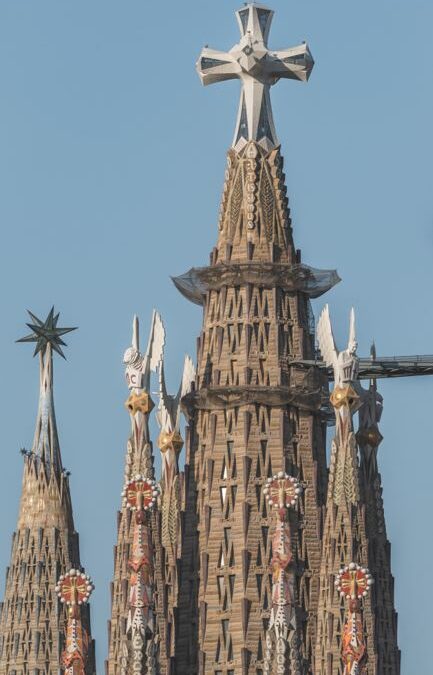
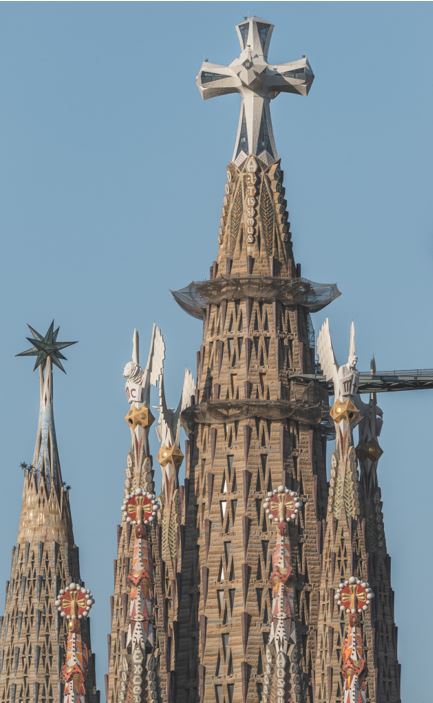
The central towers at the Sagrada Familia
About this talk
The images on the screen show the exterior of two Gothic naves (Saint Denis and Chartres) and a Solomonic column; for Antoni Gaudí, two architectural problems not entirely solved, aesthetically and structurally speaking. To understand the Tower of Jesus at the Sagrada Familia and its culmination with the three-dimensional Cross, we need to trace decades of experimentation, the evolution of his architectural language, and his search for solutions to problems such as these.
-From catenary arches to fully poly-funicular “form finding” structures that find the most natural paths for forces to descend to the ground.
-From helicoidal columns to spirals “inspired by nature” that accelerate, decelerate, or expand to transform seamlessly a column into a vault and, ultimately, to the double-helicoidal geometry of the columns at SF, with their ramifications, creating a “forest of columns and hyperbolic vaults”.
All these years of research and experimentation led Gaudí toward Non-Euclidean geometry. Poincaré said that the choice of one kind of geometry over another was a question of convenience, not of truth. And yet Euclidean geometry dominates our understanding of the world due to its influence via our built environment. Gauss classified surfaces according to the sign of their curvature; Gaudí designed the latest solutions for the Sagrada Familia’s architectural language based on “Gaussian negative or double inverse curvature”. Sigfried Giedion believed that these double-curvature surfaces, by being concave and convex at the same time, would create a new spatiality, allowing the interpenetration between inner and outer space in totally new ways; unfortunately, he failed to credit Gaudí as the pioneer.
Gaudí distanced himself from mathematical abstractions; he worked through careful observation and analogies of nature. Combining his inspiration from natural shapes and structures with his mastery of this geometry, he created a new architecture and a new spatiality.
-The Colonia Güell crypt has the first known use of hyperbolic paraboloids in history, both in the vaults and in the ribs between pillars and vaults.
-The Solomonic column problem became a long line of research, culminating in his 3rd version for the nave of Sagrada Familia. Starting with columns of double helicoidal rotation—which today would be considered “fractals”—Gaudí developed a whole system of columns, branches, and hyperbolic vaults that bring light in from above, with circular skylights where the Gothic keystones should have been.
The Towers.
Gaudí undertook a complete redesign of the Sacristy, with a cupola made entirely of hyperbolic-paraboloid shells, with the aim of applying this same geometry to all the central towers. The man at the center of the picture is Gaudí’s trusted collaborator, the architect Domènec Sugranyes. This helps explain two very important consequences of Gaudí’s “geometrization” of the whole project: the first—totally intentional—was that it allowed him to pass on all his knowledge and to teach the project to young collaborators so they could continue it after his death.
The second, unforeseeable, is that Gaudí’s new language became an ideal field for research and application in parametric design, starting almost 30 years ago. His remarkable organic architecture is nonetheless based on very strict geometrical shapes, operations, and laws that can be translated into algorithms and coded scripts, creating a fertile ground to introduce not only digital algorithmic design, but also digital fabrication. The image here shows the topological transformations of the Sacristy model used to generate the shape of all the central towers.
The Cross.
Gaudí tended to crown all his buildings with a three-dimensional Cross. The one at the Sagrada Familia is special, as it includes an interior space. Various texts describe its exterior as mosaic and crystal, reflecting sunlight and refracting it: “refulgent”, “fulgurant”, “iridescent”. Geometrically, he achieved a similar shape to his other crosses, but by applying the double-helicoid method he invented for the columns of the nave. Fortunately, a few original plaster models and molds were preserved, and the geometry could be replicated. A video explains this more clearly.
To achieve a materiality as close as possible to the original sources, a long research-and-development process took place. First, to subdivide the helicoidal surfaces into modular pieces, we used a similar resource to the one he applied at Colonia Güell: splitting the pieces into triangles. This same resource was also used by his successors to create the hyperboloid “Catalan vaults” at SF. For the Cross, this subdivision was done by a coded script; however, the principles are not different.
The prototypes for glass and ceramic show flat and pyramidal pieces to create a crystalline and refulgent effect. The pieces are so specific to this project that their fabrication is partly artisanal, partly mechanized. At the same time, the design process included computational tools previously unavailable, like solar studies and computational fluid dynamics, for passive ventilation and thermal strategies to aid the architects and engineers.
However, all these technical resources in the design and construction process only make sense insofar as they allow us to materialize Gaudí's Cross in a way that is more faithful to the original sources, as well as to erect a building that endures over a long time.